Activities
Boy Scouts of America is a boy-lead program. The boys run the meetings and plan the activities. Many of the skills acquired by new scouts will be taught by more senior scouts. (The best way to learn a skill is to try to teach it to someone else.) Youth hold leadership positions and adult leaders provide guidance and support. The adults do their best to make sure that the activities are carried out in a safe manner and serve as instructors and quality control on the skills being learned. All local leadership is made up of volunteers who give several hours a week and often one weekend a month to help the Scouts. Here in Jakarta, our troop consists of many expat families that may be here for 2 to 5 years.
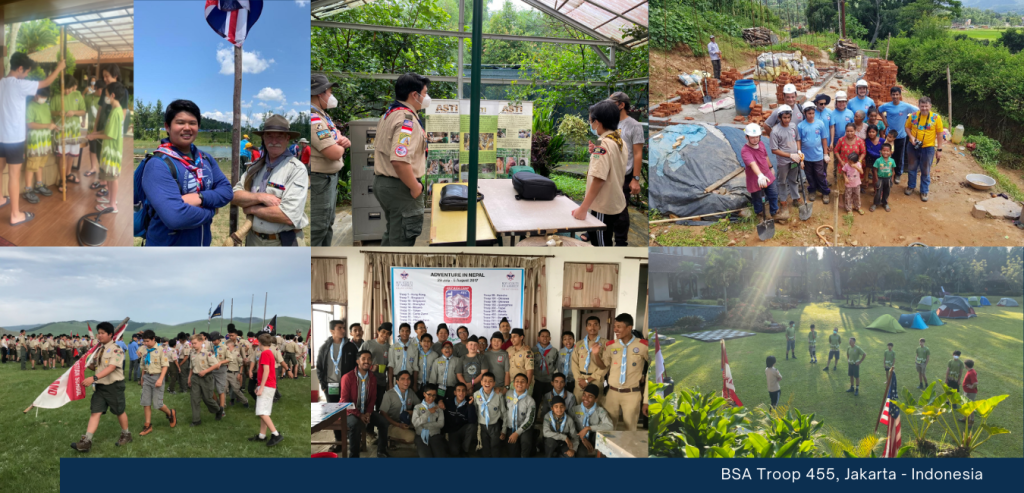
Troop meetings and Expectations of Scouts
Meetings are held on Tuesdays from 6:30 to 8 pm, usually on the 3rd floor of the Highschool cafeteria. Weekly troop meetings are used for teaching and learning scout skills, working on advancements, merit badges, planning upcoming campouts, and occasionally games and competitions. Scouts who come prepared (with their handbook and pen) and who participate in the activities will likely make steady progress in the rank advancements. Scouts who choose to do other activities (sit in the corner and surf the internet or do homework or contribute to the general chaos) will likely not make much progress. Attendance alone does not pass off requirements. For young scouts (who would often prefer to run around), having a parent join the troop meeting on occasion may be what is needed to help them get started. The Scout Masters will invite and encourage all scouts to make progress, but greater attention will be given to those who are willing to put in the necessary effort.
Absentees and Tardiness
We recognize that boys who participate in Scouts are involved in many other activities that often have conflicting schedules. We also recognize that, at times, Scouts will need to prioritize school assignments ahead of Boy Scouts. Scouts are encouraged to plan and work ahead so that they can attend Scout meetings and activities. This is particularly important for Scouts who are serving in Troop leadership positions. Poor attendance will likely prevent a scout from successfully serving in a leadership position.
At most troop meetings, we will arrange to cover one or more requirements. Special Merit Badge classes are offered a few times a year to assist scouts. Sending proxies to represent scouts at meetings, activities or merit badge classes is not the same as the scout attending themselves and defeats the purpose of teaching a scout to be independent. Scouts that miss the meetings or show up late can often pass off the requirement at another troop meeting, campout, or with the merit badge councilor. Scouts can learn the skills (it’s in the handbook or the merit badge pamphlets) and do the activities on their own. Please recognize that assisting scouts in doing make-up work for a meeting that they missed will be lower priority than a meeting’s planned activities.
Annual Swim Test
To participate in certain water related activities (sailing, white water rafting, swimming, etc.), each year scouts must pass the BSA swimmer test6. (This is also part of the Second Class and First Class requirements, and Swimming Merit Badge). As a troop, we try to conduct this annual test at a Tuesday night troop meeting in the JIS swimming pool for all the boys within the first month of the academic year. (The troop funds pay the cost associated with reserving the pool.) If your scout misses this meeting or fails to pass the swimming test, they will not be able to participate in some water-related activities. Make-up swim tests (time, location, 2-deep leadership) will need to be arranged with one of the Scout Masters.
Advancement Requirements
Scouts are expected to be knowledgeable of and have a basic proficiency in the skills required for rank advancements and merit badge completion. Senior scouts are often involved in instructing and determining if a requirement has been met, but adult scout leaders may override the decisions of youth leaders by either passing off a requirement or asking the scout to keep trying until he has mastered the skill. Scouts are expected to do all requirements themselves. Parents may provide encouragement and can assist, but the scout is expected to do the requirement. The scout master decides and authorizes who signs off rank advancement requirements. In our troop, scouts should first work their patrol leaders, senior patrol leaders, and troop guide to pass requirements. Scout masters may also sign off requirements, but scouts should first work with their youth leaders.
Youth Leadership Requirements
To attain the ranks of Star, Life and Eagle, scouts must serve in a leadership position for a period of time (4 months for star, 6 months for life and eagle). For star and life ranks in leu of severing in a leadership position, scouts may carry out a Scoutmaster-approved leadership project to help the troop. Those working towards the eagle rank must serve in a leadership position. The scouts will elect their senior patrol leader, from a group of scouts pre-approved by the Scout Master. Those seeking this position should have good attendance, demonstrated leadership in previous scout positions and submit a written statement to the Scout Master describing why he wants to be the SPL and what he plans to do in that position. It is expected he will serve in that position for school calendar year. Other positions will be assigned to scouts based on 1) need before 18th birthday cut off. 2) Life advancing to Eagle 3) Star advancing to Life and 4) 1st class advancing to Star. Scouts should not expect to serve in a leadership position until they have reached the rank of 1st class. Assignments will be made in consultation between the SPL and the Scout Masters. Any scout accepting a leadership position is expected to be active in that position for the specified period. Failure to demonstrate leadership activities and qualities will result in not passing the requirement and removal from that position. Scout Masters will serve as mentors to assist boys in their leadership roles. Because the troop is only active when JIS is in session, the time in leadership positions is only counted from Mid-August to Mid-December (4 months), and Mid-January to Mid- May (4 months). If a scout was active in his leadership position when the troop was not meeting, he may petition to have that time accredited. (Such as going to Summer Camp in July)
The handbook lists several positions that could qualify for leadership. For Troop 455, the following leadership positions qualify for Life and Eagle leadership requirements: Senior Patrol Leader, Assistant Senior Patrol Leader, Patrol Leader, and Troop Guide. For Star leadership requirements, in addition to the previous positions, scouts may serve as Den Chief, Scribe, Chaplain Aid, Instructor, or Quartermaster. If a scout wishes to serve in one of the positions listed in the handbook but not listed above (Webmaster, Historian, etc.), he will develop a plan as to how he will demonstrate leadership in that position and get approval by the scout master. (Don’t bother asking about Bugler!)
Boards of Review
To complete each rank (except Scout), the scout must pass a board of review. The board of review consists of 3 to 6 adults who are not that scout’s parents, or one of the Scouts Masters. The purpose of the board of review is not a retest, examination or a challenge to the Scout’s knowledge or skills. “A Scout may be asked where he learned his skills and who taught him, and what he gained from fulfilling selected requirements. The answers will reveal what he did for his rank. It can be determined, then, if this was what he was supposed to do. Discussion of how he has lived the Scout Oath and Scout Law in his home, unit, school, and community should be included. We must remember, however, that though we have high expectations for our members, as for ourselves, we do not insist on perfection. A positive attitude is most important, and that a young man accepts Scouting’s ideals and sets and meets good standards in his life.”7 The troop needs assistance from parents to serve on the Boards of Review. Once the Board of Review is complete, the rank advancement is recorded and the “clock” for the next rank may begin. A scout does not need to wait for the next court of honor to begin working on his next rank.
Campouts
We try to have 5 campouts each academic year with each campout lasting two nights. Generally, we leave JIS by 16:30 on Friday and return Sunday early afternoon. Scouts are strongly encouraged to take the transportation arranged by the troop.
Campouts are a lot of fun, but also are tiring, strenuous and involve work. Scouts are expected to work together in patrols to set up camp, cook, clean and take down camp. Unless otherwise stated, Scouts should plan to eat with their patrol, (not individual food plans). Scouts serving as Grub Master (rotating assignment) for their patrol, will be given money to buy all the food for their patrol for that campout. Parents will be advised of scouts who habitually avoid work. The only ones excused from work are the Scout Masters 😉.
Summer Camp
The Far East Council organizes a week-long summer camp usually the last week of July. The location changes year to year, usually between Nepal, Mongolia and Thailand. Scout camps are a terrific opportunity to earn a lot of merit badges and camping nights.
Duty to God Meetings (usually Sunday morning at campouts)
A scout promises to do his duty to God and to be reverent. Occasionally we will hold a non- denominational meeting (often Sunday morning at campouts) where scouts are encouraged to share what he sees as his duty to God and how that relates the Scout Law. Scouts may offer a prayer, song or share a brief scripture or story from their faith tradition. Attendance and participation in this meeting is optional and no one religion will be emphasized over another. Organizing this meeting would be the responsibility of the Chaplain Aid (a youth scout leadership position). Participation in this meeting is one way of meeting a requirement of communication merit badge.
Courts of Honor
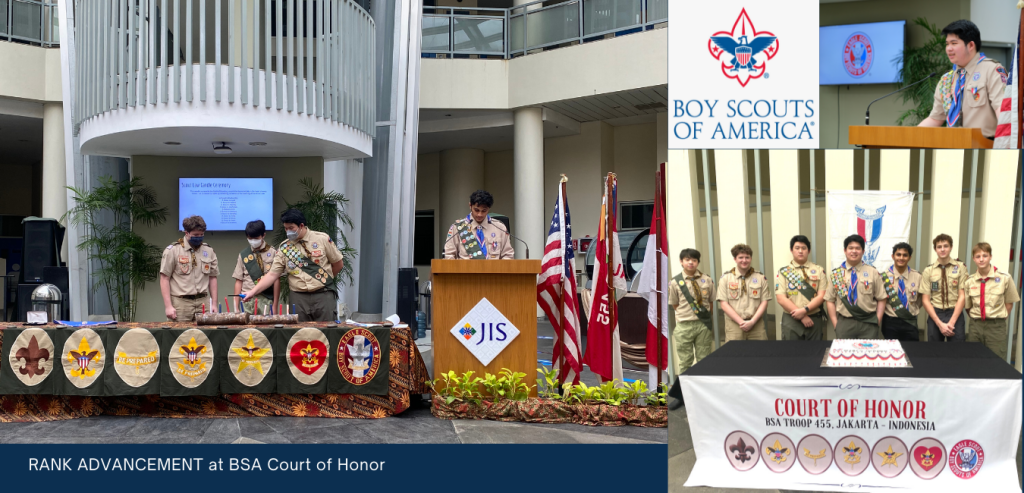
A court of honor is held on the Second Sunday of December and the Second Sunday of May. At the Troop meeting about 12 days prior to the COH, all evidence of rank advancement and earning of merit badges will need to be submitted to the assistant scout master in charge of advancement so that awards can be prepared for the COH. Scouts may continue to work on advancement after this cutoff date, but will only receive the awards that were completed by the cutoff date. All awards are purchased from the troop funds. Usually there is potluck meal that follows. The troop will provide the paper plates and cups and plastic utensils.
Eagle Court of Honor
A separate court of honor is held for Scouts attaining the rank of eagle. Usually this is held immediately following the regular troop court of honor. In addition to the Eagle awards, the troop also provides a cake in honor of the new eagle scouts.
Other Troop Activities
There will be occasionally other troop meetings, such as merit badge workshops, service projects, and socials.
Order of the Arrow
This is an honor society for Boy Scouts. Applicants must be nominated by their troop and participate in the “Ordeal”. Nominations usually occur around February. The Order of the Arrow is not required for any rank advancement. If you are interested, please contact one of the Scout Masters who can provide further information.